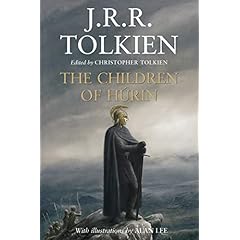
 Today, I got my (early) birthday present...The Children of Hurin. Ever since J.R.R. Tolkien's death in 1973, his son, Christopher, has done a remarkable job editing and publishing his father's unfinished (or better said, unpublished) writings. The earliest versions of The Children of Hurin go back about 90 years, to the end of WWI, when Tolkien began writing his most beloved epic, much of which was published posthumously as The Silmarillion. Although a portion of the tale was told in The Silmarillion, this new book is the most complete, readable version. I can't wait to dig into this story, and the timing couldn't be any better because I'm currently reading John Garth's biography, Tolkien and the Great War.
Showing posts with label Tolkien. Show all posts
Showing posts with label Tolkien. Show all posts
Tuesday, April 17, 2007
A New Tolkien Book: The Children of Hurin
Today, I got my (early) birthday present...The Children of Hurin. Ever since J.R.R. Tolkien's death in 1973, his son, Christopher, has done a remarkable job editing and publishing his father's unfinished (or better said, unpublished) writings. The earliest versions of The Children of Hurin go back about 90 years, to the end of WWI, when Tolkien began writing his most beloved epic, much of which was published posthumously as The Silmarillion. Although a portion of the tale was told in The Silmarillion, this new book is the most complete, readable version. I can't wait to dig into this story, and the timing couldn't be any better because I'm currently reading John Garth's biography, Tolkien and the Great War.

Tuesday, January 24, 2006
"We're in the same tale still!"
I never read Tolkien as a kid. My sister did though. I remember seeing The Hobbit on her bedroom floor once and noticing the dragon on the cover I asked her about it. She said something to the effect that it was a challenging read that I might be someday worthy of. Needless to say, I put off J.R.R.T until the Fellowship of the Ring hit the theatres. I watched the movie and wast totally gripped. Within a week I got my hands on the original sources. Immediately, my wife, Heidi, and I read through The Lord of the Rings, aloud together. It was a blast! Almost every night, we'd spend an hour or two (sometimes even more!) caught up in the drama, wondering what would happen next.
Our journeys into Middle Earth continued for months. One day, I became big-time convicted that I was more captivated by the drama of Tolkien than the drama of Scripture. In an amazing way, reading Tolkien introduced me to the significance of Biblical Theology. As great as it was (and continues to be) to travel alongside of Frodo throughout Middle Earth, it is earth-shattering to realize that I have a role in the Drama of Scripture. I, too am caught up in a epic drama of God's Creation, Humanity's Rebellion, and the Messiah's Redemption. The story Frodo and Sam found themselves in didn't begin at Biblo's one hundred and eleventieth birthday party. It goes way back to Illuvatar's creation of Arda (earth), the rebellion of Melkor, the arrival of elves and men, the forging of the Silmaril jewels and the wars that ensued. The complexity and unity of the Tolkien's story helped reveal the amazing story that Scripture describes.
The following quote describes the "Aha!" moment I experienced several years ago, when, like Samwise Gamgee, it dawned on me that I belong to a much larger story than I ever imagined.
J.R.R. Tolkien, The Lord of the Rings 50th Anniversary Edition (New York: Houghton Mifflin, 2004), p. 711-712.
Our journeys into Middle Earth continued for months. One day, I became big-time convicted that I was more captivated by the drama of Tolkien than the drama of Scripture. In an amazing way, reading Tolkien introduced me to the significance of Biblical Theology. As great as it was (and continues to be) to travel alongside of Frodo throughout Middle Earth, it is earth-shattering to realize that I have a role in the Drama of Scripture. I, too am caught up in a epic drama of God's Creation, Humanity's Rebellion, and the Messiah's Redemption. The story Frodo and Sam found themselves in didn't begin at Biblo's one hundred and eleventieth birthday party. It goes way back to Illuvatar's creation of Arda (earth), the rebellion of Melkor, the arrival of elves and men, the forging of the Silmaril jewels and the wars that ensued. The complexity and unity of the Tolkien's story helped reveal the amazing story that Scripture describes.
The following quote describes the "Aha!" moment I experienced several years ago, when, like Samwise Gamgee, it dawned on me that I belong to a much larger story than I ever imagined.
‘I don’t like anything here at all,’ said Frodo, ‘step or stone, breath or bone. Earth, air and water all seem accursed. But so our path is laid.’
‘Yes, that’s so, said Sam. ‘And we shouldn’t be here at all, if we’d known more about it before we started. But I suppose it’s often that way. The brave things in the old tales and songs, Mr. Frodo: adventures, as I used to call them. I used to think that they were things the wonderful folk of the stories went out and looked for, because they wanted them, because they were exciting and life was a bit dull, akind of a sport as you might say. But that’s not the way of it with the tales that really mattered, or the ones that stay in the mind. Folk seem to have been just landed in them, usually—their paths were laid that way, as you put it. But I expect they had lots of chances, like us, of turning back, only they didn’t. And if they had, we shouldn’t know, because they’d have been forgotten. We hear about those as just went on—and not all to a good end, mind you; at least not to what folk inside a story and not outside it call a good end. You know, coming home, and finding things all right, though not quite the same—like old Mr. Bilbo. But those aren’t always the best tales to hear, though they may be the best tales to get landed in! I wonder what sort of a tale we’ve fallen into?’
‘I wonder,’ said Frodo. ‘But I don’t know. And that’s the way of a real tale. Take anyone that you’re fond of. You may know, or guess, what kind of a tale it is, happy-ending or sad-ending, but the people in it don’t know. And you don’t want them to.’‘No, sir, of course not. Beren now, he never thought he was going to get that Silmaril form the Iron Crown in Thangorodrim, and yet he did, and that was a worse place and a blacker danger than ours. But that’s a long tale of course, and goes on past the happiness and into grief and beyond it—and the Silmaril went on and came to Earendil. And why, sir, I never thought of that before! We’ve got—you’ve got some of the light of it in that star-glass that the Lady gave you! Why to think of it, we’re in the same tale still! It’s going on. Don’t the greatest tales never end?’
J.R.R. Tolkien, The Lord of the Rings 50th Anniversary Edition (New York: Houghton Mifflin, 2004), p. 711-712.
Sunday, February 13, 2005
Tolkien links and more
Just added some links to the blog. Check out the NY Times archive on Tolkien; the articles go all the way back to the first printing of the Hobbit. You can even hear J.R.R. himself reading selections from the LOTR trilogy! Enjoy.
Wednesday, January 26, 2005
What's a "Eucatastrophe"?
“The peculiar quality of the ‘joy’ in successful Fantasy can thus be explained as a sudden glimpse of the underlying reality or truth. It is not only a ‘consolation’ for the sorrow of this world, but a satisfaction, and an answer to that question, ‘Is it true?’ . . . . [I]n the ‘eucatastrophe’ we see in brief vision that the answer may be greater–-it may be a far-off gleam or echo of evangelium in the real world . . . .The Gospels contain a fairy-story, or a story of a larger kind which embraces all the essence of fairy-stories. They contain many marvels--peculiarly artistic, beautiful, and moving: ‘mythical’ in their perfect, self-contained significance; and among the marvels is the greatest and most complete conceivable eucatastrophe. But this story has entered History and the primary world; the desire and aspiration of sub-creation [those who write and enjoy fanatasy literature] has been raised to the fulfillment of Creation.
The Birth of Christ is the eucatastrophe of Man’s history. The Resurrection is the eucatastrophe of the story of the Incarnation. This story begins and ends in joy. It has pre-eminently the ‘inner consistency of reality.' There is no tale ever told that men would rather find was true....But this story is supreme;and it is true. Art has been verified. God is the Lord, of angels, and of men--and of elves. Legend and History have met and fused."--J.R.R. Tolkien, Tree and Leaf, 88-89.
The Birth of Christ is the eucatastrophe of Man’s history. The Resurrection is the eucatastrophe of the story of the Incarnation. This story begins and ends in joy. It has pre-eminently the ‘inner consistency of reality.' There is no tale ever told that men would rather find was true....But this story is supreme;and it is true. Art has been verified. God is the Lord, of angels, and of men--and of elves. Legend and History have met and fused."--J.R.R. Tolkien, Tree and Leaf, 88-89.
Subscribe to:
Posts (Atom)