Brian Regan is one of THE funniest comedians out there! And he does it without cursing every other word. He's original and hilarious. Give a listen.
Wednesday, September 19, 2007

Friday, August 31, 2007
Free MP3's from Sovereign Grace

All of Sovereign Grace Ministries MP3 messages, conferences, and sermons are FREE!!!!
You can download 'em here.
If you're trying to avoid IPOD gluttony, Bob Kauflin @ Worship Matters has sifted out a "Top 20" messages on worship: theology, leadership, musicians and tech teams, songwriting, children, and (my fav category) misc.
Download here.
Thursday, August 23, 2007
"$3 worth of Gospel, please!"
From D. A. Carson's Basics for Believers: An Exposition of Philippians, pp. 12-13.
Via: Between Two Worlds.
I would like to buy about three dollars worth of gospel, please.Not too much – just enough to make me happy, but not so much that I get addicted.
I don’t want so much gospel that I learn to really hate covetousness and lust.
I certainly don’t want so much that I start to love my enemies, cherish self-denial, and contemplate missionary service in some alien culture.
I want ecstasy, not repentance;
I want transcendence, not transformation.
I would like to be cherished by some nice, forgiving, broad-minded people, but I myself don’t want to love those from different races – especially if they smell.
I would like enough gospel to make my family secure and my children well behaved, but not so much that I find my ambitions redirected or my giving too greatly enlarged.
I would like about three dollars worth of the gospel, please.

Via: Between Two Worlds.
Tuesday, August 21, 2007
True Worship = Changed LIves
Here's this week's Worship Quote of the Week:
I highly recommend this weekly e-letter, Chip Stam (over at SBTS) gives us gems of truth, culled from some of the best books, old and new. You'll be blessed...I promise!
P.S.TRUE WORSHIP LEADS TO FAITHFUL OBEDIENCE It should be clear by now that true worship leads to a life of faith and obedience. It is the purpose of worship, on the human side, to inspire faith and devotion to the Lord, not just for an hour, but for the whole week and for the whole life. This was the emphasis of the preaching of the prophets and the teaching of Jesus and the apostles; and this emphasis was based on the significance of worship as a covenant renewal, a ritual that not only celebrated the blessings that God has bestowed on his people through Christ but also reminded the people of their own covenant responsibilities.
At the heart of faithful obedience is personal holiness and righteousness. True worship has no place for gossip, slander, malice, envy, strife, control, or any other sin that destroys worship. Our celebration of being at peace with God must issue in living in peace with other believers. Our covenant obligations do not stop with out purging out the leaven from our lives. There is a positive side of righteousness that calls for action. If the church claims to be worshipping but has no interest in helping the poor and the homeless, the widow and the orphan, the oppressed and the foreigner, or in championing justice and equity in society, then the worship is empty. And if the worship does not prompt the work of evangelism and missions, or simply sharing the faith, then the worship has not been led by the Spirit of God. With these and many other serious matters we may test whether worship has fully achieved what God has designed it to achieve.
— Allen P. Ross, RECALLING THE HOPE OF GLORY: BIBLICAL WORSHIP FROM THE GARDEN TO THE NEW CREATION. Grand Rapids: Kregel Publications, 2006, p. 467-68. ISBN 0-8254-3578-1.
I highly recommend this weekly e-letter, Chip Stam (over at SBTS) gives us gems of truth, culled from some of the best books, old and new. You'll be blessed...I promise!
Tuesday, August 14, 2007
Andy Mckee " Drifting "
If you haven't heard this guy, stop whatever you're doing to give him a listen. I've never heard so many sounds come from one guitar. McKee's arrangements are breathtaking!
Thursday, August 02, 2007
The Perfect Preacher
This really helped me today. I take my self too seriously, too often. I struggle with worrying about whether I've made people happy and whether I've met their expectations. This brought me back to earth and up to heaven at the same time. So for today... I'm more encouraged to long for hearing Jesus say "Well done, good and faithful servant" at the end of my life than I am hearing someone from my church family say "Well done, your sermon was good today...not to mention not too long" at the end of a service.
The Perfect Preacher
After hundreds of years, a model preacher has been found to suit everyone. He preaches exactly 20 minutes and then sits down. He condemns sin, but never hurts anyone's feelings.
He works from 8 am to 10 pm in every type of work from preaching to custodial service. He makes $400 a week, wears good clothes, buys good books regularly, has a nice family, drives a good car and gives $60 a week to the church. He also stands ready to contribute to every good cause that comes along.
He is 26 years old and has been preaching for 30 years. He is short and tall, thin and heavy set, handsome. He has one brown eye and a blue one; hair parted down the middle, left side dark and straight and right side brown and wavy
He has a burning desire to work with teenagers and spends all his time with the older folks.
He smiles all the time with a straight face because he has a sense of humor that keeps him seriously dedicated to his work.
He makes 15 calls a day on church members, spends all his time evangelizing the unchurched and is never out of his office.
(How To Survive in the Ministry, Leslie Flynn, p. 16)
Tuesday, July 31, 2007
Mt. Washington 2007
I've been looking forward to my (almost) annual hike of Mt. Washington for months. I was seriously bummed that 2006 came and went before I could hike my mountain-fortress of solitude. So it's no surprise that I cashed in some vacation time last week for some serious hiking and some serious downtime with Jesus, the Creator-Redeemer himself.
The forecast was not too promising, saying a chance of showers and cloudy all day. Which is not good news when you're trekking toward the "home of the world's worst weather." But I started off at about 7:30am. I hiked up the Lion's Head trail, ate a fantastic lunch at the summit, took a wrong turn down to Lake of the Clouds, hiked back up to the Bootspur trail via the Camel Path, finally began the long-descent back to Pinkham notch, showered up, enjoyed a fantastic burger at the Muddy Moose while watching Dice-K and the Sox take one from the Tribe.
Here are some of the best pics of the day. I hope you enjoy!
 The Road Most Traveled--Tuckerman Ravine Trail.
 First view of blue sky, a ridge of Tuckerman Ravine (Bootspur side).
 A cairn with wooly-white cloud backdrop.
 First view of Lion's Head.
 Another view of Lion's Head and Tuckerman Ravine
 Atop of Lion's Head.
 Another helpful cairn, assuring my safe passage
 The deceptive summit of Mt. Washington (objects are NOT closer than they appear!)
 Looking back onto Lion's Head.
 The path I should have taken later on in the day!
 Ah, the summit of Mt. Washington!
 I should not have been this close to the Lake of the clouds...missed the connector.
 Closeup of the Lake of the Clouds Hut.
 Looking back to where I was, wishin' I hadn't been. (nearly a 2 mile detour!)
 Things are starting to get a little creepy!
 Split Rock. It was like that...I didn't do it.
 Blog Profile Pic 2.0
 My favorite rock overlooking Tuckerman Ravine.
The forecast was not too promising, saying a chance of showers and cloudy all day. Which is not good news when you're trekking toward the "home of the world's worst weather." But I started off at about 7:30am. I hiked up the Lion's Head trail, ate a fantastic lunch at the summit, took a wrong turn down to Lake of the Clouds, hiked back up to the Bootspur trail via the Camel Path, finally began the long-descent back to Pinkham notch, showered up, enjoyed a fantastic burger at the Muddy Moose while watching Dice-K and the Sox take one from the Tribe.
Here are some of the best pics of the day. I hope you enjoy!
 The Road Most Traveled--Tuckerman Ravine Trail.
 First view of blue sky, a ridge of Tuckerman Ravine (Bootspur side).
 A cairn with wooly-white cloud backdrop.
 First view of Lion's Head.
 Another view of Lion's Head and Tuckerman Ravine
 Atop of Lion's Head.
 Another helpful cairn, assuring my safe passage
 The deceptive summit of Mt. Washington (objects are NOT closer than they appear!)
 Looking back onto Lion's Head.
 The path I should have taken later on in the day!
 Ah, the summit of Mt. Washington!
 I should not have been this close to the Lake of the clouds...missed the connector.
 Closeup of the Lake of the Clouds Hut.
 Looking back to where I was, wishin' I hadn't been. (nearly a 2 mile detour!)
 Things are starting to get a little creepy!
 Split Rock. It was like that...I didn't do it.
 Blog Profile Pic 2.0
 My favorite rock overlooking Tuckerman Ravine.
Recent Sermon: The Meal Jesus Gave Us
A few weeks a ago I had the privilege of preaching at CenterPoint Church, in Concord, NH. Their lead pastor, Dave Spencer, and I used to serve together in South Portland. It was great time catching up with him and his family, and I was deeply encouraged by the group of Jesus followers that had gathered to worship there in the capitol that morning.
I preached a sermon called "The Meal Jesus Gave Us" (nod to N.T. Wright). In it, I give an overview of what the Lord's Supper is all about, and spent some time explaining two key OT background passages: Jeremiah 31:31-34 and Isaiah 25:6-9. (Pretty hard to do in about 30 minutes!) I cannot tell you how faith-invigorating Isaiah 25 has been to me over the past few years and how fills my heart with expectant joy whenever I drink the cup and eat the bread. If you have a chance to listen, I hope you're encouraged by what you hear.
Listen/download here.
I preached a sermon called "The Meal Jesus Gave Us" (nod to N.T. Wright). In it, I give an overview of what the Lord's Supper is all about, and spent some time explaining two key OT background passages: Jeremiah 31:31-34 and Isaiah 25:6-9. (Pretty hard to do in about 30 minutes!) I cannot tell you how faith-invigorating Isaiah 25 has been to me over the past few years and how fills my heart with expectant joy whenever I drink the cup and eat the bread. If you have a chance to listen, I hope you're encouraged by what you hear.
Listen/download here.
Thursday, July 19, 2007
More Zeke!
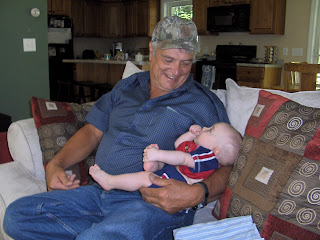
Yeah we can't get enough of him either! Here's a bunch of pics of Zechariah. Everything from just relaxing in the lazyboy, to hanging with Grandpa O., to his first feeding of rice cereal...and prunes!






Acadia National Park Trip
Back in early June, my sister, Phyllis, and her hubby, Ben, finally made it up to Acadia National Park. We joined them for the weekend and drove all over the island, walked around Bar Harbor, heard the crashing of Thunder Hole, ate at the Jordon Pond Carriage House, saw the sunset at Cadillac Mtn. Had a FANTASTIC time. Zeke was the most patient, chill, happy baby even after 5+ hours on the road. Here are some highlights from the trip.
 Just the three of us...on Sand Beach (photo by my sister, Phyllis).
 The family at Thunder Hole.
 My sister, Phyllis, and her husband, Ben.
 A view driving up Cadillac Mtn.
 Sunset driving up Cadillac Mtn.
 Dead tree watching the sunset with us.
 Beaver dam near Jordan Pond.
 Back at Thunder Hole looking towards Sand Beach.
 Yep. Thunder Hole again, looking not towards Sand Beach.
 Heidi and Zechariah just chillin'.
 Bass Harbor.
 Me and my favorite sister.
 Just the three of us...on Sand Beach (photo by my sister, Phyllis).
 The family at Thunder Hole.
 My sister, Phyllis, and her husband, Ben.
 A view driving up Cadillac Mtn.
 Sunset driving up Cadillac Mtn.
 Dead tree watching the sunset with us.
 Beaver dam near Jordan Pond.
 Back at Thunder Hole looking towards Sand Beach.
 Yep. Thunder Hole again, looking not towards Sand Beach.
 Heidi and Zechariah just chillin'.
 Bass Harbor.
 Me and my favorite sister.
Saturday, July 14, 2007
More Him We Proclaim Resources
For those of you interested in Dennis Johnson's new book Him We Proclaim, I've got a few more new resources you're gonna want to listen to and read!
For starters, the White Horse Inn recently interviewed Dennis Johnson. In about 1/2 an hour you can get a the skinny on this pretty fat book. My buddy Dave let me know about this...To think I've been living like a pauper when all along I already had this interview podcast in my ITunes! Crazy! You can download the interview here.
Next and last, Colin Adams of Discerning Reader recently gave a very helpful overview and review of Him We Proclaim. Whether you've started reading the book or not, it will help you climb this worthy mountain of a book.
For starters, the White Horse Inn recently interviewed Dennis Johnson. In about 1/2 an hour you can get a the skinny on this pretty fat book. My buddy Dave let me know about this...To think I've been living like a pauper when all along I already had this interview podcast in my ITunes! Crazy! You can download the interview here.
Next and last, Colin Adams of Discerning Reader recently gave a very helpful overview and review of Him We Proclaim. Whether you've started reading the book or not, it will help you climb this worthy mountain of a book.
Commentary on the New Testament's Use of the Old

I heard rumors in the halls of Gordon-Conwell about this book. Finally we've got a pretty solid release date (Nov. 2007) for Beale and Carson's Commentary on the New Testament's Use of the Old Testament. The list of contributors is stellar, and their insights will no doubt bring a fresh breath of air into the commentary world, opening new perspectives into texts that we wrongly thought we had all figured out.
Professors, pastors, small groups leaders, and every Jesus follower should have this book on their shelf ASAP.
If you're wondering what to gift to get me for Christmas, don't bother with this one...I'm pre-ordering it right away. (But if you're really wondering, feel free to drop me a line and I'll send you my Wishlist!)
Thursday, July 12, 2007
6 months ago...
I slept for 8 hours in a row.
I was timing contractions, hoping we'd get to the Birthplace in time.
I fell in love with Heidi all over again as she gave birth to my son.
I saw my son for the first time.
I knew nothing about fatherhood (update: I still know practically nothing).
I never knew the joy of seeing my son smile or laugh for the first time...the gazillionth time.
I couldn't have understood the magnitude of the love that a father has for his child.
That's right, but I would never want to back to 6 months ago. I absolutely love being a dad. Heidi and I have only begun to know the joys and sorrows of parenthood. Yet our love for Zechariah is greater than the fear and frustrations that we've already encountered and will sooner or later. We constantly thank God for supplying us wisdom to know how to love this little guy.
Happy 6 Month Birthday Zechariah!


I was timing contractions, hoping we'd get to the Birthplace in time.
I fell in love with Heidi all over again as she gave birth to my son.
I saw my son for the first time.
I knew nothing about fatherhood (update: I still know practically nothing).
I never knew the joy of seeing my son smile or laugh for the first time...the gazillionth time.
I couldn't have understood the magnitude of the love that a father has for his child.
That's right, but I would never want to back to 6 months ago. I absolutely love being a dad. Heidi and I have only begun to know the joys and sorrows of parenthood. Yet our love for Zechariah is greater than the fear and frustrations that we've already encountered and will sooner or later. We constantly thank God for supplying us wisdom to know how to love this little guy.
Happy 6 Month Birthday Zechariah!


Tuesday, July 10, 2007
Him We Proclaim 3.2
Let's wrap up the Paul's theology of preaching.
5. The price we pay: "suffering …Christ's afflictions…toil, struggling."
Someone once said the Greek word for "pastor" is "toilet." Somedays it feels like that! Paul himself said we are the scum of the earth, the dregs of all things. But to be honest, when I feel this way it usually has little to do with the actual proclamation and defense of Jesus as Lord, as Savior. It usually has to do with my weakness as a leader or my inability to meet someone's expectations. What Paul has in mind in Colossians 1, though, is a visible, physical representation of Jesus on earth today. As preachers we are entrusted with the most profound responsibility: to speak for God, as Jesus would. Yet like Jesus, we too will suffer. In fact everyone who desire to live like Jesus will suffer, just as he did. If Jesus suffered in life and death for trusting in and proclaiming the word, the message of God who are we to think we're off the hook?
"Apostolic preaching is no nine-to-five job at which employees put in the required hours and then leave workplace worries behind at day's end, paychecks in hand, to pursue their 'real lives.' To be entrusted with the treasure of God's gospel is not a responsibility that can be switched 'off' and 'on' at will." (p. 86)
" Paul, however, awakens us from fantasyland [that people always shower preachers with admiration, respect, and appreciation] and introduces us to the real world: those who would practice apostolic preaching must be prepared for both toil and suffering." (p. 90)
If you're thinking of becoming a pastor, read Paul's "job description" in his 2nd letter to the Corinthians (11:23-33) first.
6. The power on which we rely: "all his energy…within me."
Cool PowerPoint/Media Shout presentations, Swindoll's Tale of the Tardy Oxcart, mimicking Mark Driscoll, studying 20hrs/week, buying sermons online…none of these things will ensure effective preaching. This is not to say that we should abandon creativity, relevant communication, and diligent study. "Apostolic preaching puts no premium on obscurity, disorganization, or indifference to the hearer's level of understanding." (p. 91) But there is something more vital to preaching than homiletical strategy: prayerful dependence. Paul was keenly aware that his ministry effectiveness was dependent upon God's power working in and through him. Read his prayers, pray his prayers, live his prayers: Eph. 1:15-19; 3:14-19; Col. 1:9-12.
"Preachers like Paul, who realize their own desperate need and the Spirit's almighty power, will saturate their ministry of the Word with prayer—for their hearers, themselves, and each other—and will urgently seek the support of others' prayers." (p. 92)
7. The office we fulfill: "minister according to the stewardship from God."
We are stewards, not kings. In the Return of the King, Tolkien graphically portrays the abuse that comes when one forgets his office. Denethor, though just a steward of Gondor, acted as though he were king, and pride clouded his reason, obscured his responsibilities, and fueled his despair. When the time came for him to relinquish the throne for the true King, his trust in his own will was so great that he would not acknowledge the true heir. Anyway…read the book.
In a similar way, Paul says "we are stewards of the great King. Don't forget it!"
"Having been entrusted with his Master's richest treasure, 'the mysteries of God' (the gospel once hidden but now revealed), and having been charged to use it for the Master's purposes, Paul the steward is answerable for the conduct of his trusteeship when the Master 'audits the books.'" (p. 94)
"The preacher speaks in God's name, and he does so not only as one who will some day give an account for his handling of the divine Word (2 Tim. 2:15) but also as one who stands today in the very presence of the God whose word he proclaims." (p. 95)
Discussion Questions:
- Prayer is one of the most tangible ways that we can minister (esp. preaching) in the strength God supplies. What are some other ways that we can be reminded of and empowered by God's strength?
- How do you maintain a prayerful dependence upon God in your preaching? What are some of your disciplines?
- Preaching=Suffering. How has weekly preaching opened your eyes that ministry is not a day at Disneyland?
- How does the gospel give you hope in carrying out the humanly-impossible task of preaching?
Him We Proclaim 3.1
Preaching Christ is preaching grace. They're virtually synonyms. You can't have one without the other.
Last time, we identified 7 interwoven themes that together form an "apostolic theology of preaching." Now let's look at the first four of them a little more in depth.
1. The purpose we pursue: "to present everyone mature in Christ."
THE purpose…THE foundation… THE non-negotiable…of preaching is to be God's mouthpiece in his "Creation Project":
"Through preaching Christ Paul seeks to recreate people into the image of God, so they enjoy God's presence in unashamed purity, serve his will in unreserved love, express God's justice and mercy in relationships with each other." (p. 66)
Notice, Johnson's and Paul's emphasis is in on "people", community rather than individuals. Ours is the day of "me and Jesus" rather than "us and Jesus" so we need to let this sink in. The important themes of "maturity", "the body of Christ", and being "in Christ" point to the fact that God is not rescuing individuals willy-nilly, but is gathering a redeemed community that will live and love like Jesus on earth right now. And it is this community that mirrors in its interrelationships with each other a reflection of the image of the Holy Community, the Triune God himself. And it is preaching that God has ordained as a means of making this happen.
"The same gospel that initially called us to faith is the means that perfects us in faith…..The same gospel, faithfully preached, accomplishes both evangelism leading to conversion and edification leading to sanctification—both individual and corporate renewal together." (p. 68, 69)
2. The listeners we address: "to make known…among the Gentiles."
Apostolic preaching, new covenant preaching is by default missiological preaching. Why? Because God is calling men, women, and children from every nation to abandon their life-bleeding idols and to turn to His life-giving Son, Jesus.
"When God does the diagnosis through his whole Word, he pierces through the surface symptoms all the way to the heart, with the radical cure of God's holy truth exposing our infection in all its ugliness and applying Christ's amazing grace in all its sweetness and strength." (p. 71)
The purpose in preaching is to announce to peoples everywhere that reign of the Redeeming-Creator, Jesus, has begun and that there is no nation, people group, or culture that is exempt from his rule or redemption. The message of our preaching is not tied down to a particular language or geography. Apostolic preachers are missional preachers.
3. The content we preach: "Him we proclaim."
"How can contemporary preachers preach 'nothing but Christ' and at the same time preach the whole Bible as it addresses the whole spectrum of spiritual and ethical issues that confront our readers?" (p. 75)
In other words how can the simple notion of "preaching Jesus" possibly be enough? How can "Jesus" be the answer to all of life's questions, fears, frustrations, pursuits and joys? Is this just preacher talk? I don't think so. Have you ever noticed how much Jesus-talk Paul goes through when he talks to his Christian friends, when he prays for them, when he tells them how to do money, how to do sex, how to do parenting, how do singleness, how to do career, how to do entertainment, how to do conversation,…how to do life? He always calls his friends to orient/re-orient their life to the reality of how God has changed the world through Jesus. Paul demands that they live every aspect of their life in view of the actual death and resurrection of Jesus and the new creation that dawned because of it.
So here are the essentials of "preaching Jesus":
Christ reveals God the Creator with a fullness and clarity unmatched by any other mode of revelation. The goal, or perfection/maturity that God has for his creation is out on public display in Jesus.
Christ's supremacy is clearly seen in his role as the reconciler of God's people. Jesus is the only cure for the lethal sickness of sin and death.
Preaching Christ is preaching the fulfillment of God's redemptive plan for history. We'll never make sense of the OT unless we understand how pointed to and is fulfilled in Jesus. We'll never figure out what it means to follow Jesus unless we believe that he is the hinge-point of history.
4. The communication tasks we perform: "warning and teaching…with all wisdom."
"Preaching not only informs the mind but also employs truth to appeal to emotions and to challenge the will to respond in ways appropriate to the truth revealed in the gospel." (p. 85)
That's a lot to expect out of preaching, out of preacher! But that about sums it up (cf. 1 Timothy 3:16). That's why the 4 approaches in chapter 2 are not all wrong. The first three are just over simplified, emphasizing one aspect over another. Apostolic preaching is dynamic communication.
Well, that's it for now; we'll tackle 5-7 on "Him We Prolcaim 3.2."
Discussion Questions:
- If the purpose of preaching is 'maturity in Christ', what does this maturity look like? How do we measure it?
- How does viewing our preaching as missional clarify the purpose, content and communication methods of our preaching?
- Is there really an insurmountable chasm between "preaching Jesus" and preaching to "felt needs"? Shouldn't "preaching Jesus, and him crucified" address felt needs?
Monday, July 09, 2007
Him We Proclaim 3.O
Last time we asked something along the lines of "What is effective preaching?" We saw several different approaches, each having significant and biblical strengths. But we never got down to the real question, "What is the effect that preaching is supposed to have?" That's what we're after in our review of chapter 3 of Him We Proclaim.
He starts off by saying,
"We cannot evaluate our strengths and weaknesses in preaching, nor our progress in strengthening strengths and minimizing weaknesses unless we know what preaching is supposed to do, what purpose it is to accomplish." (p. 63)
So the author sets off on the lofty goal of answering what "preaching is supposed to do" by exploring the Apostle Paul's theology of preaching from a paragraph of his letter to the Colossian Christians. (This where the title of the book comes from too!)
We proclaim Him, admonishing every man and teaching every man with all wisdom, so that we may present every man complete in Christ. For this purpose also I labor, striving according to His power, which mightily works within me.
Colossians 1:28-29
From this text and its surrounding paragraph, Johnson detects 7 interwoven themes that undergirded the Apostle's preaching and should undergird ours as well.
They are…
- The purpose we pursue: "to present everyone mature in Christ."
- The listeners we address: "to make known…among the Gentiles."
- The content we preach: "Him we proclaim."
- The communication tasks we perform: "warning and teaching…with all wisdom."
- The price we pay: "suffering …Christ's afflictions…toil, struggling."
- The power on which we rely: "all his energy…within me."
- The office we fulfill: "minister according to the stewardship from God."
This chapter is worth reading, re-reading, and re-reading again. What I love most about it is that our friend doesn't just pull this stuff out of the air, but right from the man himself, the apostle Paul. And he doesn't even have to pull together a bunch of Paul's random thoughts from all of his letters. He piggybacks off of Paul's reflection on his own task as a preacher.
Next time, well take a look at these 7 themes of "apostolic theology of preaching."
Discussion Questions:
- What other passages would you go to form a 'biblical theology of preaching'?
- What effects should our preaching have: on us, on our listeners? In other words, what should preaching do?
- How would you state (in one sentence) the purpose of preaching?
Thursday, July 05, 2007
Overdressed

You can now pre-order the new Caedmon's Call cd, Overdressed, and for a limited time, you'll get two cds for $12! Talk about generosity. This way you can share their truth-saturated music with a friend.
Great album art, huh?!
Tuesday, July 03, 2007
Him We Proclaim Reading Schedule
Just to make your life a little easier, I'm posting the reading schedule that we're following this summer. Don't forget! You can simplify your reading avoid browsing the whole blog simply by clicking on the label "Him We Proclaim" either in the post or on the right hand column under "Labels". This will give you access to all of the "Him We Proclaim" posts.
Here we go...
Here we go...
| June 10 | Chapter 1: Introduction: Preaching Like Peter and Paul, p. 1 Tim Keller’s “Centrality of the Gospel” |
| June 17 | Part 1: The Case for Apostolic, Christocentric Preaching Chapter 2: Priorities and Polarities in Preaching, p. 25 |
| June 24 | Chapter 3: Paul’s Theology of Preaching, p. 62 |
| July 1 | Chapter 4: The Complication, Chastening, Rejection, and Recovery of Apostolic Preaching in the History of the Church, p. 9 |
| July 8 | Chapter 5: Challenges to Apostolic Preaching, p. 126 |
| July 15 | Part 2: The Practice of Apostolic, Christocentric Preaching Chapter 6: The Epistle to the Hebrews as an Apostolic Preaching Paradigm, p. 167 |
| July 22 | Chapter 7: Theological Foundations of Apostolic Preaching, p. 198 |
| July 29 | Chapter 8: Preaching Christ, Head of the New Creation and Mediator of the New Covenant, p. 239 |
| August 5 | Chapter 9: Preaching the Promises: Apostolic Preaching of Old Testament Literary Genres, p. 272 |
| August 12 | Chapter 10: Preaching the Promise Keeper: Apostolic Preaching of New Testament Literary Genres, p. 331 |
| August 19 | Appendix A: From Text to Sermon 397 Appendix B: Sample Sermons in the Trajectory of Apostolic, Christ-Centered Preaching 409 |
| August 26 | Wrapping things up! |
Saturday, June 30, 2007
Him We Proclaim 2.0
Who are your favorite preachers?
What do you consider good preaching?
What makes a "good" preacher?
When does a preacher "cross the line" from preaching to teaching? From sermon to lecture?
What does a "biblical" preacher look like?
Ok…that's enough. Even if you answered these questions with a concordance in your hand there is a boatload of subjectivity laced throughout your answers. My answers. Now, I've only been in supported ministry for a cumulative 6 years, but it seems to me that if you've got a church of about 150 people you've got at least 200 opinions when it comes to "this is the way a preacher should preach."
That's the reality we have to have in mind as we read Johnson's second chapter of Him We Proclaim. It's called "Priorities and Polarities in Preaching" (pp. 25-61) for good reason. If there's one area a pastor can be tempted relentlessly to cower to the idol called "Fear of Man" or "Foolishly Trying to Meet Everyone's Expectations" it's the area of preaching. Thankfully, Johnson gives some good advice for us to navigate the fluctuating opinions of preaching.
"Because human nature is prone to oversimplification and imbalance, differences of opinion on priorities to be pursued in preaching easily degenerate into polarization." (p. 27)
Of course I've opened up a can of worms, and neither this chapter , or my post, will answer all of the questions about what makes good, biblical preaching. Instead, we're gonna talk about purpose.
Our author identifies three general purposes of preaching are 1. To convert, 2. To edify, and 3. To instruct. Since you have the book (or could buy the book and read along with us) I won't reiterate the chapter. But essentially, Johnson summarizes (at length) the strengths and weaknesses of these three preaching purposes. The 30 pages are well worth reading and will help you work through some very practical issues: felt needs, evangelism vs. edification, theological jargon, value redemptive-historical, the indicative and the imperative, etc.
Then in the last 10 pages, he recommends another purpose. It's really a hybrid of the three (especially #3) and is what the book contends for. He dubs it a very cumbersome, yet meaningful title: "Evangelistic, Edificatory Redemptive-Historical Preaching."Even if you don't read the footnotes (which you should in this case), you'll notice right away his interaction with/reliance upon Tim Keller. In fact if you've heard Tim Keller preach, then you've got an inkling of what Johnson is proposing. He defines this kind of preaching like this:
"Preaching must be Christ-centered, must interpret biblical texts in their redemptive-historical contexts, must aim for change, must proclaim the doctrinal center of the Reformation (grace alone, faith alone, Christ alone, God's glory alone) with passion and personal application, and must speak in a language that connects with the unchurched in our culture, shattering their stereotypes of Christianity and bringing them face to face with Christ, who meets sinner's real needs—felt and unfelt." (p. 54)
Keller gives props to his mentor Edmund Clowney and sees his method right in line with Clowney's redemptive-historical approach. He just kicks it up a notch. Here are some foundational characteristics of this "gospel changes everything" kind of preaching.
- Biblical Theology, Biblical Theology, Biblical Theology! If that term doesn't mean anything to you, if it doesn't cause your heart to skip an exegetical beat, then you need to repent and get saved…or at least read up a little bit more. Johnson gives a summary that'll do for now: "It emphasizes the unity of the history of redemption—the enactment of God's plan for the rescue, reconciliation, and re-creation of his people, climaxing in the person, obedience, sacrifice, resurrection, and exaltation of Jesus Christ, and reaching consummation at his return in glory." (pp.48-49) Biblical Theology (BT) is the discipline that traces all of the promises made in the OT to the promises kept in the NT (thank you, Mark Dever). One key result of BT is that we always see Jesus as the hero of every OT narrative: "The purpose of the Old Testament historical narrative is not to teach moral lessons, but to trace the work of God, the Savior of his people, whose redeeming presence among them reaches it's climatic expression in Christ's incarnation." (p.51)
- Believers and unbelievers both need to hear the gospel in preaching. As Keller says, "the gospel is not just the A-B-C's but the A to Z of Christianity."
- The root of all sin and misery is idolatry. "Our idols are whatever (other than the triune God) we trust in to gain 'salvation,' however we define it—whatever we believe that we cannot live without." (p. 57)
- Preachers and congregations must assume the presence of unbelievers in gathered worship and therefore not always speak in only Christianese. Rather than dumb down the gospel, though, the preacher should take apologetic sidebars that challenge non-Christians with the coherence of biblical truth and its superior ability to address the dilemmas of human life and thought.
Having read on, I'll encourage you that Johnson does a good job explaining how we can preach like this, but for now let's get to some discussion.
Discussion: (pick one and comment)
- How would you define biblical preaching? What's it look like? What does "meaty" preaching look like?
- Do you think that preaching can be intelligible enough for unbelievers and still remain edifying for believers? Why/not?
- What are some challenges that you've faced in preaching in a redemptive-historical fashion?
- In what ways is Keller's approach ("Evangelistic, Edificatory Redemptive-Historical Preaching") different from seeker-sensitive preaching?
- Have you taught or preached the Bible (esp. the OT) in a moralistic way? How does biblical theology help us move away from that?
- How do you combat the "fear of man" and the tyranny of others' expectations when it comes to preaching?
Tuesday, June 19, 2007
Basic Biblical Theology Resources
As we're reading through Him We Proclaim I wanted to make sure that we're all on the same page when we're talking about Biblical Theology. So here's a couple quotes and some resources you'll want to have handy.
"What is Biblical Theology?" from Beginning With Moses. Tons of great articles on biblical theology that are especially helpful for sermon preparation.
"Biblical Theology" from Monergism. THE place to go for anything that has to do with Reformed theology. Tons of links and articles covering almost every facet of Biblical Theology.
"Biblical Theology" from 9 Marks. The second mark of a healthy church is one committed to biblical theology. Check out the other 8!
"9News on Biblical Theology" from 9 Marks. An entire 60 page newsletter discussing the "ins" and "outs" of Biblical Theology.
From the evangelical preacher's point of view, biblical theology involves the quest for the big picture, or the overview of biblical revelation. It is of the nature of biblical theology that it tells a story rather than sets out timeless principles in abstraction. It does contain many timeless principles, but not in abstract. They are given in an historical context of progressive revelation. If we allow the Bible to tell its own story, we find a coherent and meaningful whole.
Graeme Goldsworthy, Preaching the Whole Bible as Christian Scripture, 22.
To understand the Bible as a single divinely-inspired narrative, a revelation of God’s purpose and plan for humanity that unfolds in time and space, is the task of biblical theology. More than just theology that is biblical, biblical theology attempts to understand God’s revelation as it progressively unfolds in history and culminates in the person of Jesus Christ. It tries to understand how the Old Testament points forward to and prepares us for the New, and how the New Testament is contained in the Old.Links:
Michael Lawrence, "Where is Your Story Written", Nov-Dec 06 9News.
"What is Biblical Theology?" from Beginning With Moses. Tons of great articles on biblical theology that are especially helpful for sermon preparation.
"Biblical Theology" from Monergism. THE place to go for anything that has to do with Reformed theology. Tons of links and articles covering almost every facet of Biblical Theology.
"Biblical Theology" from 9 Marks. The second mark of a healthy church is one committed to biblical theology. Check out the other 8!
"9News on Biblical Theology" from 9 Marks. An entire 60 page newsletter discussing the "ins" and "outs" of Biblical Theology.
Subscribe to:
Posts (Atom)